Raleigh Building Permit Guide for Homeowners: Complete Guide

If you're planning a remodel in Raleigh, permits are not optional for most projects — and the rules are more specific than most homeowners expect. This guide covers exactly when a Raleigh building permit is required, how the process works, what trade permits mean for your kitchen or bathroom renovation, and what happens if work starts before approval. Everything here comes directly from the City of Raleigh and the North Carolina Residential Code.
Does Your Project Require a Raleigh Building Permit?
A Raleigh building permit is required any time your project affects the structure of a home, alters a load-bearing element, adds square footage, or involves significant trade work. The City of Raleigh follows the North Carolina Residential Code and enforces these requirements through its Planning and Development Department.
Structural Work That Always Needs a Permit
Any work that touches the bones of your home requires a permit. That includes removing, adding, or altering load-bearing or non-load-bearing walls, modifying beams, columns, headers, or structural framing, and finishing or converting attic or basement spaces into living areas.
New Construction and Expansions
Adding a room, converting a garage, or building an addition all require permits. Decks attached to the house require a permit, as do porches, sunrooms, and accessory structures larger than 12 feet in any dimension.
Window and Door Opening Changes
If you are changing the size of a window or door opening — or reframing an existing one — a permit is required. Swapping a window in the same opening without structural changes is a different matter, covered below.
Also Read: Practical Checklist for Planning Your First Home Renovation
Trade Permits in Raleigh: Electrical, Plumbing, and Mechanical
Trade permits are separate from building permits and are one of the most misunderstood parts of Raleigh's permitting system. Even if your remodel does not involve structural changes, it may still require one or more trade permits. These cover the systems behind your walls — and they must be pulled by a licensed contractor unless you qualify for the homeowner exemption.
When an Electrical Permit Is Required
You need an electrical permit when installing new circuits or outlets, upgrading a panel or electrical service, running or relocating wiring, installing recessed lighting, EV chargers, or generators, or replacing hardwired appliances. A basic fixture swap in the same location with no new wiring typically does not require a permit.
When a Plumbing Permit Is Required
A plumbing permit is required any time supply lines or drain lines are installed or relocated, fixtures such as sinks, showers, bathtubs, or toilets are moved, water heaters are replaced (tank or tankless), or new exterior hose bibs are added. Moving a toilet even a few inches in a bathroom remodeling project triggers a plumbing permit.
When a Mechanical Permit Is Required
Mechanical permits apply to HVAC installs and replacements, ductwork additions or relocations, exhaust fans that require new ducting, and any gas piping work. Replacing a unit in the same location with no ductwork changes may qualify for a simplified process, but still requires a permit.
Also Read: What a Proper Waterproofing System Looks Like Behind Tile
Work That Does Not Require a Raleigh Permit
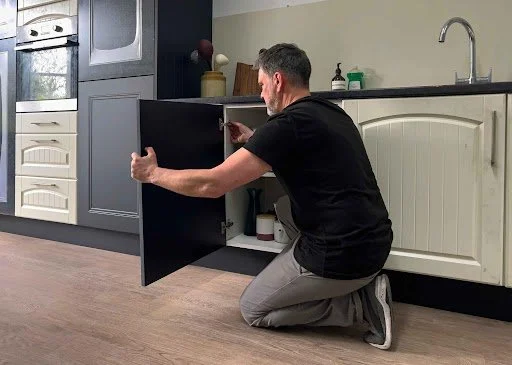
Raleigh allows homeowners to complete many common improvements without a permit, as long as no structural changes or trade work are involved. The North Carolina Residential Code specifically exempts non-structural residential work totaling less than $40,000. Confirmed examples include:
Painting interior walls and ceilings
Installing flooring — tile, hardwood, vinyl, or carpet — without subfloor structural changes
Replacing cabinets without changing the layout
Replacing countertops
Installing interior trim or molding
Swapping plumbing fixtures if no pipes are moved
Replacing lighting fixtures in the same location without adding circuits
Repairing drywall that does not affect fire-rated assemblies
If you are in stalling tile flooring as part of a larger bathroom renovation, the flooring itself may not require a permit but the plumbing or structural work happening in the same project likely does.
Who Can Apply for a Raleigh Building Permit?
Raleigh allows homeowners to apply for and pull their own permits under specific conditions. You qualify for the homeowner exemption when the property is your primary residence, you are the one performing the work, and you are not hiring out the labor to an unlicensed individual. If a contractor is doing the work, that contractor must apply for the permit under their own license. Raleigh verifies contractor licenses through the NC Licensing Board before issuing permits.
This matters in practice. If a contractor tells you they will "handle the permits" but cannot show you a license number, that is a red flag.
How the Raleigh Permit Process Works Step by Step
Raleigh manages all permit applications through the Raleigh Permit and Development Portal. The process is entirely online for most residential projects. Here is how it works from start to finish.
Step 1 — Submit Your Application Through the Portal
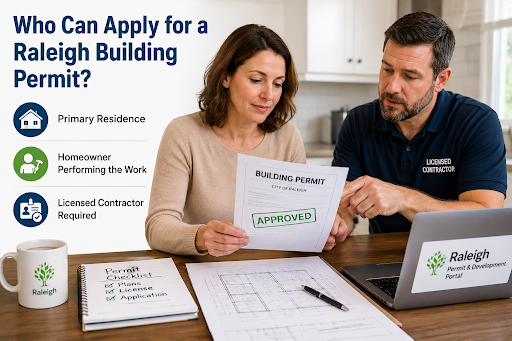
Register an account on the Raleigh Permit and Development Portal. Upload your application, site plan survey, construction drawings, and lien agent assignment. For residential projects, Raleigh uses the Residential Permit Application form available from the Development Forms page.
Step 2 — Plan Review
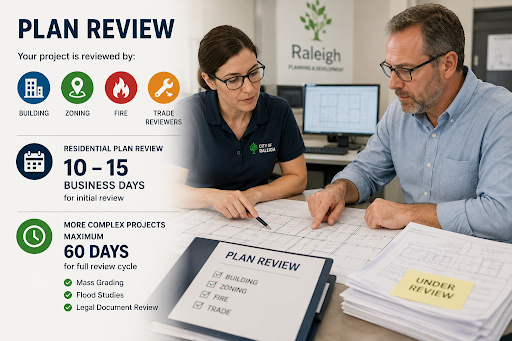
Once submitted, your project is reviewed by building, zoning, fire, and trade reviewers depending on scope. Residential plan review typically takes 10 to 15 business days for the initial review. More complex projects involving mass grading, flood studies, or legal document review may take longer — Raleigh's stated maximum is 60 days for the full review cycle.
Step 3 — Permit Issuance
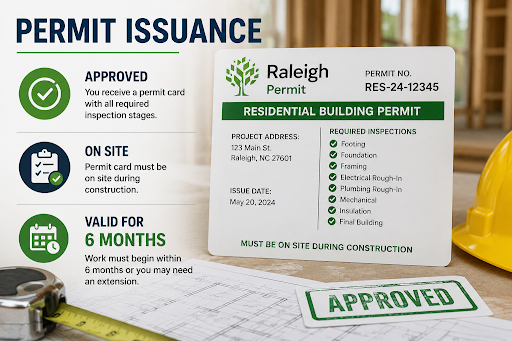
Once approved, you receive a permit card that lists all required inspection stages. This card must be on site during construction. Your permit is valid for 6 months from the date of issuance — work must begin within that window or you may need to apply for an extension.
Step 4 — Required Inspections During Construction
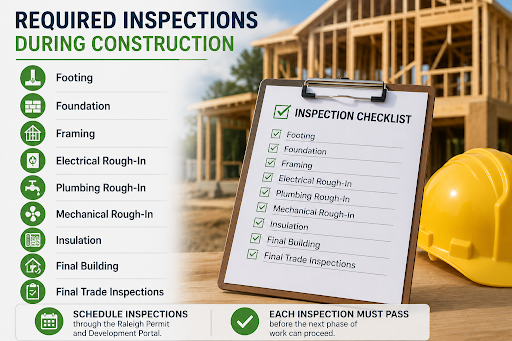
Inspections are required at specific points — not just at the end. Skipping or reordering inspections can result in failed finals or required demolition of completed work. Common residential inspection stages include:
Footing
Foundation
Framing
Electrical rough-in
Plumbing rough-in
Mechanical rough-in
Insulation
Final building
Final trade inspections
Schedule inspections through the same Raleigh Permit and Development Portal. Each inspection must pass before the next phase of work can proceed.
Step 5 — Final Approval and Permit Closeout
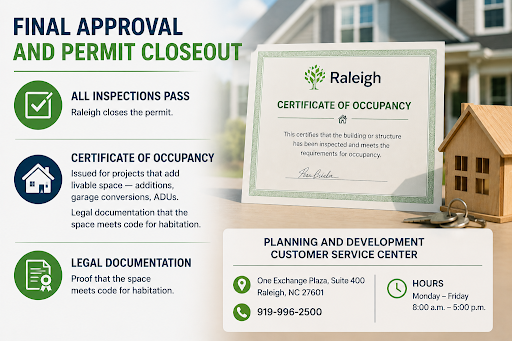
Once all inspections pass, Raleigh closes the permit. For projects that add livable space additions, garage conversions, ADUs a Certificate of Occupancy is issued. This is your legal documentation that the space meets code for habitation.
If you need in-person help at any stage, the Planning and Development Customer Service Center is located at One Exchange Plaza, Suite 400, Raleigh, NC 27601. They are open Monday through Friday, 8:00 a.m. to 5:00 p.m. The phone number is 919-996-2500.
Also Read: How Much Does Hardwood Floor Installation Cost? (2026)
Special Permit Rules Raleigh Homeowners Should Know
Several specific project types confuse homeowners — either because they assume a permit is not needed, or because the rules are more detailed than a general guide covers. These come directly from Raleigh permitting standards and the North Carolina State Code.
Roof Replacement and Permits
Many homeowners ask whether they need a permit to replace their roof in Raleigh or whether they can do it themselves without one. In North Carolina, a full roof replacement is considered a structural repair and typically requires a building permit. If any decking, rafters, or structural sheathing are being replaced, a permit is required. Re-roofing over existing material in limited circumstances may qualify for an exemption, but any work involving structural roof members does not. Licensed roofing contractors are required to pull permits for replacement projects under their license.
Decks — Attached vs. Freestanding
Decks attached to the house always require a building permit. Freestanding decks may qualify for an exemption depending on height and size but any deck above 30 inches from grade requires a permit regardless of attachment. When in doubt, check with the City of Raleigh before starting.
Water Heater Replacements
Replacing a water heater tank or tankless always requires a plumbing permit in Raleigh. This applies to both new installations and direct replacements. There is no exemption for like-for-like swaps. This is one of the most commonly skipped permits by homeowners and unlicensed workers.
Basement and Attic Bedrooms
Any new sleeping space added to a home finished basement bedroom, attic conversion must meet egress requirements. That means an approved emergency escape opening of specific dimensions. This is a life-safety code requirement, not optional. It triggers both a building permit and typically an electrical permit for smoke detector placement.
Garage Conversions
Converting a garage to living space requires compliance with conditioned space standards: insulation, ventilation, electrical, and structural upgrades all apply. This almost always involves multiple permits building, electrical, and mechanical at minimum.
Also Read: What Is the Best Way to Install Hardwood Floors?
What Happens If You Start Work Without a Permit in Raleigh
Raleigh is clear: no construction may begin until the permit is issued. This rule applies to demolition, framing, plumbing relocations, electrical work, and removal of load-bearing elements. Starting early is not just a procedural problem, it creates real financial and legal exposure.
If an inspector discovers unpermitted work, they can require the area to be opened for examination, meaning finished walls, flooring, or ceilings may have to come down so inspectors can verify what is behind them. In some cases, the inspector can require the work to be removed and redone entirely.
Beyond city enforcement, unpermitted work affects your home's resale value and your homeowner's insurance. If a claim involves unpermitted construction, insurers can deny coverage. Buyers and their inspectors routinely check permit history and unpermitted work can kill a sale or require renegotiation at closing.
If your siding replacement or sheetrock repair is part of a larger remodel that does require permits, making sure the full scope is permitted upfront is always the cleaner path.
How a Licensed Raleigh Remodeling Contractor Makes Permits Easier
Permits are not just paper work they require accurate drawings, correct sequencing, and coordination with city reviewers at multiple stages. A licensed contractor who regularly works in Wake, Johnston, and Durham counties understands how Raleigh's system operates. That experience shortens review times and prevents the kind of inspection failures that push timelines back by weeks.
A licensed contractor handles the application, prepares documents to code standards, schedules inspections in the correct order, and communicates directly with the city when a recheck is needed. For homeowners, that means one less thing to manage during a project that already has a lot of moving parts.
Many of our clients come to us after a previous contractor did work without pulling permits. Getting that work retroactively permitted or corrected is significantly more expensive and disruptive than doing it right the first time. For any kitchen renovation involving plumbing or electrical changes, the permit process is just part of the job.
Frequently Asked Questions
Do I need a permit for a bathroom remodel in Raleigh?
It depends on what the remodel involves. Replacing fixtures in the same location without moving pipes does not require a permit. However, most bathroom remodels in Raleigh involve relocating plumbing, adding electrical circuits, or making structural changes — all of which require permits. If any pipes move or any walls are altered, expect to pull both a building permit and at least one trade permit.
Do I need a permit to replace my roof myself in Raleigh?
In most cases, yes. North Carolina considers a full roof replacement a structural repair. If any structural roof members decking, rafters, or sheathing are being replaced, a building permit is required. Homeowners may apply for their own permit if the property is their primary residence and they are performing the work themselves. That said, roofing work involves real safety risk, and most insurers expect licensed contractors on structural roofing jobs.
How long does a Raleigh building permit take?
Residential plan review in Raleigh typically takes 10 to 15 business days for the initial review. More complex projects or those requiring additional reviews — zoning, flood, legal — can take up to 60 days total. Submitting a complete, accurate application is the single best way to avoid delays.
How long is a Raleigh building permit valid?
A Raleigh building permit is valid for 6 months from the date it is issued. Work must begin within that period or you will need to apply for an extension. Once work is underway, the permit remains active as long as inspections are not stalled for more than 6 months at a time.
Can I do my own electrical work in Raleigh as a homeowner?
Yes, with conditions. Raleigh allows homeowners to perform electrical work on their primary residence under the homeowner exemption. You must apply for the electrical permit yourself and the work must be inspected and approved. You cannot use the homeowner exemption if you are not the primary occupant, or if you are hiring unlicensed workers to do the work under your name.
How much does a Raleigh building permit cost?
Permit fees in Raleigh are based on project type, scope, and valuation. All projects pay an initial plan review fee. From there, costs increase based on square footage, trade inspections, and complexity. The City of Raleigh provides a Development Fee Guide and Calculator on its website to help you estimate costs before submitting. For most residential remodels, permit fees represent a small fraction of the total project cost.
Ready to Start Your Raleigh Remodel? Let's Talk First.
Permits exist to protect your investment, your safety, and the long-term value of your home. Getting them right is not complicated when you work with a contractor who knows Raleigh's system. At A Hammer and Nail Construction, we handle the permit process as part of every project — not as an afterthought.
If you are planning a remodel, addition, or repair in Raleigh, Durham, Chapel Hill, or Clayton, we are happy to walk through what permits your specific project will require before any work begins. No pressure — just clear information and a realistic plan.