The best way to install hardwood floors depends on the type of flooring you’re using. For solid hardwood, a nail-down installation over a plywood subfloor is usually the most reliable method. For engineered flooring, floating and glue-down systems are also options. No matter which material you choose, the process starts long before the first plank goes down. Proper acclimation, subfloor preparation, and layout planning determine whether the floor performs well for years or develops problems within months.
In this guide, you’ll learn how to:
- Choose between solid and engineered hardwood
- Gather the right tools and materials
- Prepare your subfloor correctly
- Acclimate the flooring
- Plan your layout
- Install the floor step by step
- Avoid common installation mistakes
- Decide whether DIY or professional installation makes sense
Solid Hardwood vs. Engineered Hardwood Which Is Easier to Install?
Before learning how to install hardwood flooring, you need to know which type of flooring you’re working with.
Solid hardwood is milled from a single piece of wood. It offers a long lifespan and can be refinished multiple times. However, it requires a plywood subfloor and is typically installed using nails or staples.
Engineered hardwood consists of a hardwood wear layer bonded to multiple layers underneath. It works over concrete, performs better in areas with moisture fluctuations, and can be installed using floating, glue-down, or nail-down methods.
Solid Hardwood
Engineered Hardwood
Nail-down installation
Floating, glue-down, or nail-down
Requires plywood subfloor
Works on plywood or concrete
More difficult for beginners
More DIY-friendly
Can be refinished many times
Limited refinishing potential
The rest of this guide focuses on solid hardwood because that’s the installation method most homeowners search for when asking how do I install hardwood floors.
Also Read
Professional installation generally costs more
Tools and Materials You Need for Hardwood Installation
Having the right equipment makes the job easier and helps prevent mistakes.
Tools
- Pneumatic flooring nailer or stapler
- Air compressor
- Miter saw
- Table saw
- Tape measure
- Chalk line
- Tapping block
- Pull bar
- Pry bar
- Pull saw for door jambs
- Moisture meter
Materials
- Hardwood flooring planks
- Rosin paper or vapor barrier
- Flooring nails or staples
- Spacers
- Wood putty
- Baseboards or shoe molding
If you’re tackling a one-time project, renting a flooring nailer often makes more sense than buying one. Rental costs typically range from $40 to $60 per day.
How to Prep Your Subfloor Before Installing Hardwood Flooring
If there is one step that separates successful projects from failed ones, it’s subfloor preparation.
At A Hammer and Nail Construction, we’ve seen homeowners spend thousands on quality flooring only to have problems caused by the surface underneath.
Before installing hardwood flooring, make sure you:
- Remove existing flooring completely
- Pull old staples and tack strips
- Remove leftover adhesive
- Fix squeaks by securing loose panels
- Sand high spots
- Fill low spots
A subfloor should be flat within 3/16 inch over 10 feet.
Next, check moisture levels.
- Wood subfloors should generally be below 12% moisture content
- Concrete should meet the flooring manufacturer’s requirements
Finally, install rosin paper or a vapor barrier and overlap seams by about four inches.
Skipping these steps may save a day now, but it can create gaps, movement, and buckling later.
Acclimating Your Hardwood Floors Don’t Skip This Step
Wood reacts to its environment.
That’s why acclimation matters.
When homeowners ask us how hard is it to install hardwood floors yourself, one of the first things we discuss is patience. Many DIY failures happen because the flooring was installed immediately after delivery.
Bring the flooring into the room where it will be installed.
Then:
- Leave it there for 3–7 days
- Keep room temperature between 60–80°F
- Maintain normal indoor humidity levels
This allows the boards to adjust before installation begins.
Without acclimation, wood can shrink during dry months or expand during humid conditions.
How to Lay Hardwood Floors Layout and Direction
Many homeowners focus on nailing technique and forget that layout determines how the finished floor looks.
When deciding how to lay down hardwood floors, start by identifying the floor joists.
The strongest installation runs perpendicular to the joists.
If you cannot determine joist direction, run the boards parallel to the longest wall or toward the primary source of natural light.
Before starting:
- Measure the room width
- Divide it by the plank width
- Check the size of the final row
If the last row will be less than two inches wide, trim the first row slightly so both sides appear balanced.
Then snap a chalk line. This becomes your reference point for the entire installation.
How to Find Floor Joist Direction
One of the easiest ways to identify joist direction is by looking at the seams in the subfloor. The seams usually run perpendicular to the joists. A stud finder can also help locate them. Knowing this direction is important when deciding how do I lay hardwood flooring correctly.
Also Read
How to Find a Contractor for Home Renovations
What a Proper Waterproofing System Looks Like Behind Tile
How to Install Hardwood Flooring Step by Step
Now it’s time for the actual hardwood installation.
- Lay your vapor barrier or underlayment. Overlap seams and tape them securely.
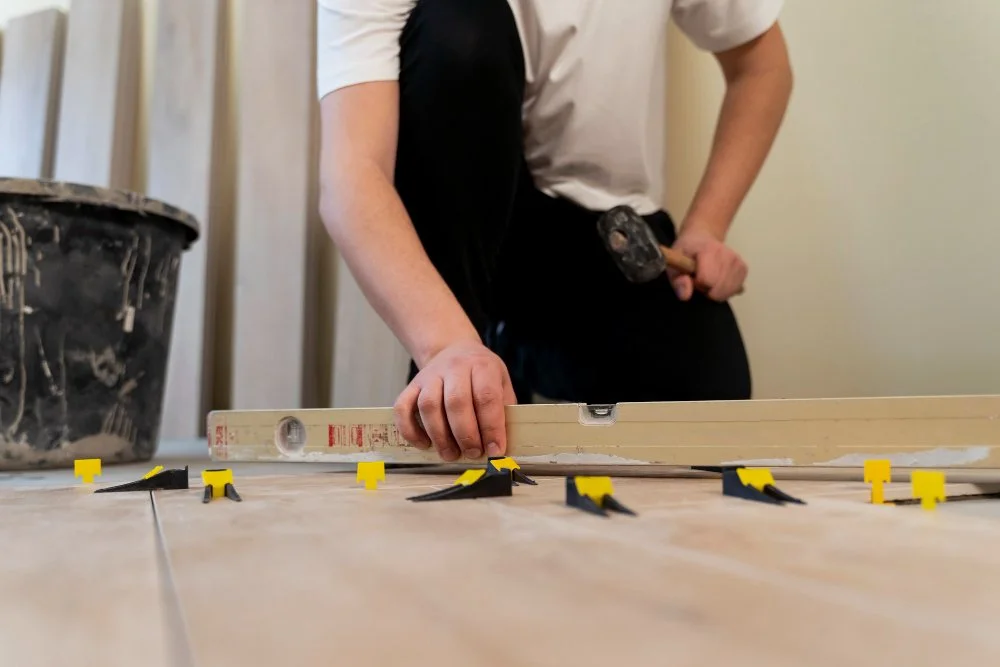
- Place spacers around the perimeter to create a ¾-inch expansion gap.
- Install the first row along your chalk line. Face-nail where the baseboard will later hide the fasteners.
- Install the second row and confirm everything remains straight.
- Switch to the flooring nailer. When installing hardwood flooring with tongue-and-groove boards, drive fasteners through the tongue at a 45-degree angle.
- Space nails every 8–10 inches and within 2–3 inches of each board end.
- Stagger end joints by at least six inches. Avoid repeating patterns.
- Undercut door jambs so flooring slides underneath rather than stopping against them.
- Continue row by row across the room.
- For the final rows, switch back to face-nailing because the flooring nailer won’t fit near the wall.
- Fill visible nail holes with matching wood putty.
- Install baseboards and shoe molding to cover expansion gaps.
If you’re researching how to install wood flooring, this process remains largely the same for most solid hardwood products.
Common Hardwood Floor Installation Mistakes to Avoid
The most common hardwood floor installation mistake is skipping moisture testing.
Other costly mistakes include:
- Not acclimating the flooring
- Starting with a crooked first row
- Nailing too close to plank ends
- Failing to stagger joints properly
- Ignoring expansion gaps
- Nailing shoe molding into the floor instead of the wall
We often see these issues when repairing failed DIY projects. Most of them could have been prevented during installation.
If you’re reading this section and feeling uncertain, it may be worth speaking with experienced remodeling contractors in Raleigh NC before starting.
Should You DIY or Hire a Contractor for Hardwood Installation?
DIY installation can work if:
- The room is simple
- The subfloor is in good condition
- You’re comfortable using power tools
Hiring a professional usually makes more sense if:
- The room has complex angles
- Stairs are involved
- Moisture issues exist
- The floor is being installed over concrete
Professional installation generally costs more, but mistakes can be expensive too.
At A Hammer and Nail Construction, we often get calls from homeowners after they’ve started a flooring project and run into problems that weren’t obvious at the beginning.
Hardwood Flooring Trends for 2026
Homeowners continue moving toward:
- Wide-plank flooring
- Matte and low-sheen finishes
- Natural oak tones
- Longer board lengths
The biggest shift we’ve noticed is a preference for flooring that looks timeless rather than trendy.
Other Home Projects to Tackle After Your New Floors
New flooring often changes how the rest of a room feels.
After a flooring project, many homeowners begin looking at:
- Trim and baseboard upgrades
- Interior painting
- Bath remodeling Raleigh NC projects
- Room updates and layout improvements
- Siding replacement in Raleigh for exterior curb appeal
One renovation often highlights opportunities in other parts of the home.
Frequently Asked Questions
How do I install hardwood floors without a flooring nailer?
For engineered flooring, you can use a floating installation system. Solid hardwood is best installed with a flooring nailer for consistent results.
How long does it take to install hardwood floors in one room?
A standard room usually takes an experienced DIYer one full day. First-time installers should expect the project to take longer.
Do I need to remove baseboards before installing hardwood flooring?
Yes. Removing baseboards creates a cleaner finished look and properly covers expansion gaps.
How much flooring should I order?
Order about 10% more than your measured square footage. Complex layouts may require closer to 15%.
Can hardwood floors be installed over radiant heat?
Engineered hardwood can often be installed over radiant heat systems. Solid hardwood is generally not recommended.